From Mudge to Breguet: 18th Century Watchmaking | Pieces of Time
From Mudge to Breguet: How 18th Century Watchmaking Created the Modern Watch
The Century That Turned the Watch Into a Precision Instrument
If the seventeenth century gave the watch its heart in the form of the balance spring, the eighteenth century gave it discipline. This was the hundred years in which the portable timepiece stopped being an unreliable ornament and became a genuine scientific instrument — accurate enough to navigate an ocean, refined enough to slip flat into a waistcoat pocket, and beautiful enough to enchant the courts of Europe. For the collector, no period rewards close study more richly. The innovations forged between 1700 and 1800 are still ticking inside almost every mechanical watch made today.
The Inheritance: Where the Century Began
The eighteenth century opened with a problem its makers had inherited from the previous one. The balance spring had transformed accuracy, but the verge escapement that drove most watches remained crude. Its balance wheel was never free; it was in constant contact with the escape wheel, recoiling with every beat, introducing friction and wear that no amount of skill could fully tame. A good verge watch was a fine thing, but it was not a precise one.
What changed everything was a shift in mindset. The leading makers of the age increasingly thought of themselves not as jewellers or craftsmen but as engineers solving a defined mechanical problem. That problem was the escapement — the small, stubborn mechanism that governs how energy is released to the balance — and the eighteenth century is, more than anything, the story of how it was conquered.
George Graham and the Cylinder Escapement
The bridge between the two centuries was George Graham, the brilliant successor to Thomas Tompion. Graham took over Tompion’s celebrated Fleet Street workshop and inherited his reputation as London’s finest. Around 1726 he perfected the cylinder escapement, a design that did away with the verge’s bulky vertical layout and allowed watches to be made dramatically thinner and flatter. For the first time, a precision watch could also be an elegant one.
Graham earned the affectionate nickname “Honest George” for his refusal to patent his improvements, preferring instead to share them so the whole trade might advance. He trained a generation of makers who would define the century — and one apprentice in particular would go on to solve the escapement problem outright.
Thomas Mudge and the Lever Escapement
That apprentice was Thomas Mudge, widely regarded as England’s greatest watchmaker. Around 1755, Mudge invented the detached lever escapement — arguably the single most important advance in the history of the watch. His design placed a pivoted lever between the balance and the escape wheel, so that for most of its swing the balance was left entirely free, receiving only a brief impulse to keep it going. The result was a leap in accuracy and a reduction in wear that no earlier design could match.
Mudge first applied the idea to a clock, and it was not until around 1770 that he built it into a watch — a magnificent piece commissioned by King George III as a gift for Queen Charlotte. He was a perfectionist who considered the lever a curiosity rather than a commercial prospect, and it would take other hands to refine it. Yet his judgement was vindicated beyond anything he could have imagined: virtually every mechanical wristwatch and pocket watch built since runs on a descendant of Mudge’s lever escapement.
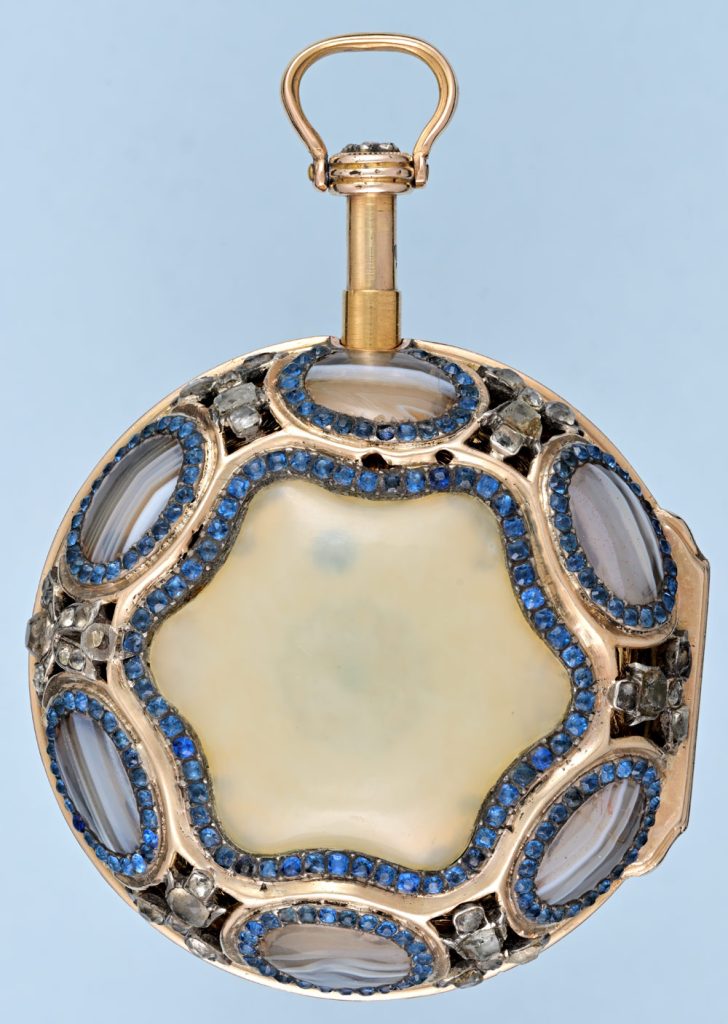
Surviving work from Mudge’s own bench is among the most coveted in the field. A spectacular example is the Rare Gold and Agate Quarter-Repeating Watch by Mudge & Dutton, circa 1780 in our collection — its 22-carat gold pair cases set with banded agate and sapphires, the cylinder movement repeating the quarters on a bell at the push of the pendant. It was made in partnership with William Dutton, who, like Mudge, had trained under George Graham, and so it captures the Graham-to-Mudge lineage of this entire chapter in a single, dazzling object.
John Harrison and the Conquest of Longitude
While Mudge pursued accuracy in the pocket, John Harrison pursued it across oceans. The eighteenth century’s most urgent scientific challenge was the determination of longitude at sea — a problem so deadly that in 1707 a British fleet wrecked on the Isles of Scilly with the loss of more than a thousand lives. In 1714 Parliament passed the Longitude Act, offering the staggering sum of £20,000 to anyone who could solve it.
Harrison, a self-taught Yorkshire carpenter and clockmaker, devoted his life to the task. Over four decades he built a series of extraordinary marine timekeepers, H1 through H4, each more refined than the last. His masterpiece, H4, completed in 1759, resembled an oversized pocket watch. On its sea trial to Jamaica in 1761 it lost only around five seconds over an eighty-one-day voyage — a precision that should have been impossible. The Board of Longitude proved reluctant to pay, and it took the personal intervention of George III before Harrison finally received his due in 1773. His achievement did more than win a prize; it proved that a portable mechanical timekeeper could be trusted with human lives.
Arnold, Earnshaw and the Practical Chronometer
Harrison solved the longitude problem, but his H4 was a handmade marvel, too complex and costly to reproduce in numbers. The task of making the marine chronometer practical fell to two rival English makers, John Arnold and Thomas Earnshaw. Working in the closing decades of the century, each developed and refined the spring detent escapement, a mechanism ideally suited to precision timekeeping at sea.
Their work, often bitterly competitive, made it possible to produce accurate chronometers in quantity and at a price the Admiralty and merchant fleets could bear. By the early nineteenth century, the British Empire’s ships were navigating by chronometers descended directly from their designs. For the collector, an Arnold or Earnshaw piece represents the moment precision timekeeping moved from a one-off triumph to a repeatable industry.
The French School: Lépine, Berthoud and the Thin Watch
Across the Channel, the French were pursuing a different kind of perfection. Around 1770, Jean-Antoine Lépine introduced a radically rethought movement layout — the Lépine calibre — which dispensed with the fusee and the traditional top plate, replacing the old architecture with individual bridges and cocks. The effect was transformative: watches could be made far thinner and more elegant than ever before. The slim dress watch we recognise today is, in essence, Lépine’s invention.
Alongside him, Ferdinand Berthoud produced France’s first marine chronometers, building on the longitude work happening in England and cementing Paris as a serious centre of horological science. The French court’s appetite for refinement and ornament drove makers to combine mechanical sophistication with extraordinary decorative artistry.
Abraham-Louis Breguet: The Genius of the Age
No survey of the eighteenth century can close without its towering figure. Abraham-Louis Breguet, born in Neuchâtel in 1747, apprenticed under both Berthoud and Lépine before establishing his own workshop on the Île de la Cité in Paris in 1775. What followed was the most fertile career in the history of horology.
Breguet’s inventions read like a catalogue of everything a fine watch can do. He created the self-winding “Perpétuelle” watch around 1780, which delighted Louis XVI and Marie-Antoinette; the gong spring that gave repeating watches their clear, musical chime; and the pare-chute shock-protection system that protected the balance from damage. His crowning achievement, the tourbillon — a rotating cage that averages out the positional errors caused by gravity — was conceived in the 1790s and patented in 1801, carrying his genius across the threshold into the new century. Add to these his unmistakable aesthetic signatures, the “Breguet” hands and the engine-turned guilloché dial, and it is easy to see why he is so often called the greatest watchmaker who ever lived.
Geneva, Enamel and the Decorative Tradition
While London chased precision and Paris chased elegance, Geneva refined the art of beauty. Swiss makers perfected the painted enamel case and the jewelled, decorated movement, producing watches whose miniature scenes rivalled fine art. These pieces, often destined for the Ottoman and Chinese export markets, demonstrate that the eighteenth century prized the watch as an object of wonder as much as a tool of science. For collectors of enamel and decorative watches, this is the period in which the form reached its first great height.
Legacy for the Modern Collector
The eighteenth century is where the modern watch was truly born. The lever escapement that powers your wristwatch, the chronometer principles that guided ships for two centuries, the slim elegance of the dress watch, the tourbillon that remains the ultimate expression of the watchmaker’s art — all of it crystallised in these hundred years.
To hold an eighteenth-century watch is to hold the moment horology grew up. A Mudge, a Graham cylinder, an Arnold chronometer, a Lépine-calibre dress watch, or a Breguet of any kind is not merely a rare object; it is a piece of the intellectual revolution that taught humanity to measure time with confidence. For the serious collector, no century offers a deeper or more rewarding field of study.
Pieces of Time Ltd holds one of the world’s finest selections of eighteenth-century pocket watches. Explore our 18th Century Watches collection, or browse our Repeating and Musical Watches and Enamel & Decorative Watches for pieces from this remarkable age.